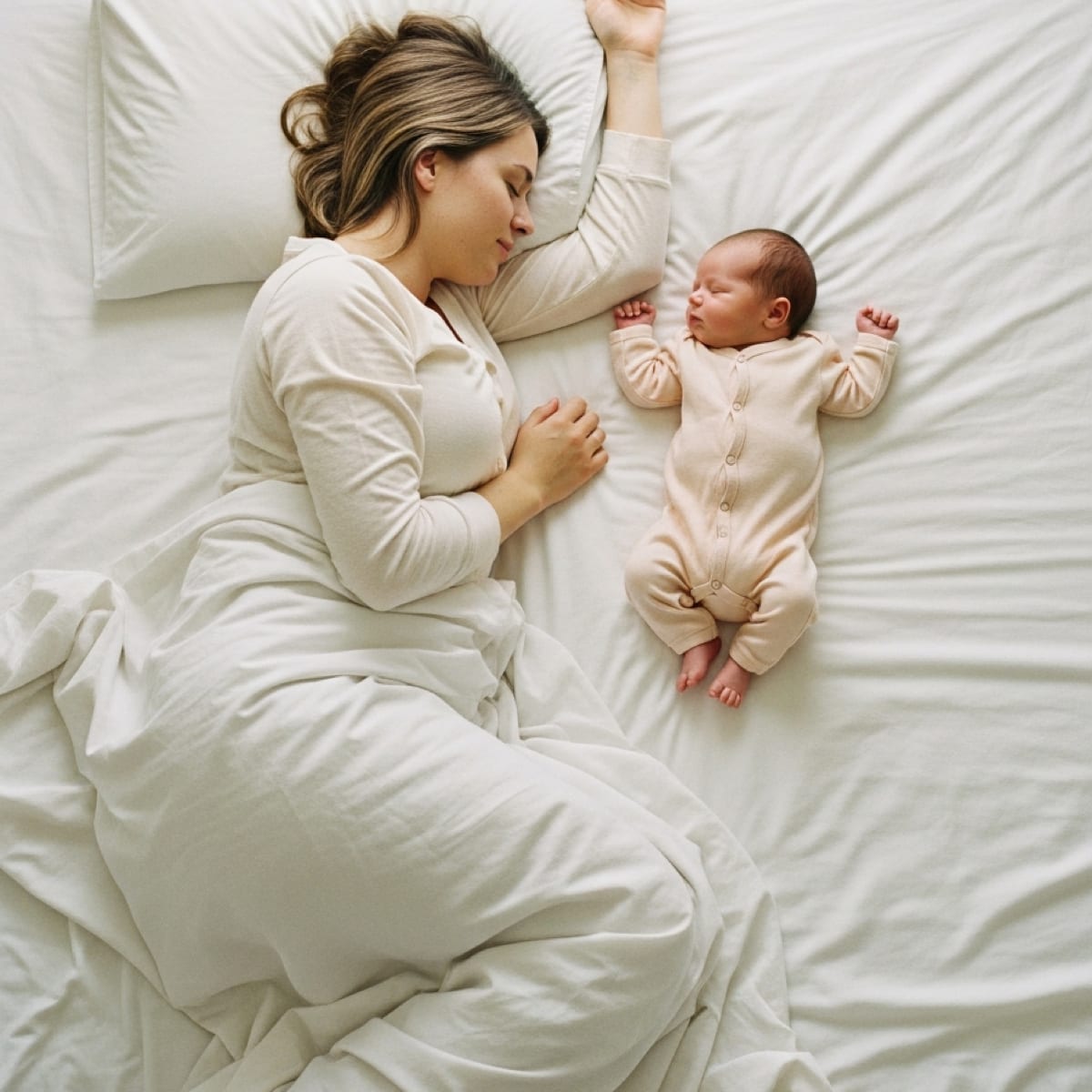
Co-sleeping with a breastfed baby can be done safely. When a breastfeeding mother meets a short list of conditions known as the Safe Sleep Seven, La Leche League considers bed-sharing about as safe as a crib. The safety lives in three things: your setup, your own body, and a few firm rules you keep every single night.
I gave birth to my son at home in Bali. The first night he was earthside, putting him anywhere other than right next to me was unfathomable. The relief of him there, breathing against me, was so visceral and so complete that I understood in that moment that this is where he belongs.
This is one mother's experience and a plain-language summary of published safe-sleep guidance. It is not medical advice. Talk to your paediatrician about your own family. Last reviewed: June 2026.
Co-sleeping, bed-sharing, room-sharing: what's the difference?
These three terms get used interchangeably, and they mean different things.
Co-sleeping is the umbrella term. It simply means sleeping in close proximity to your baby, in the same room, on the same surface, or both.
Bed-sharing is a specific form of co-sleeping where you and your baby sleep on the same surface: your mattress, a floor bed, or any shared sleep space.
Room-sharing is where your baby sleeps on their own separate surface, such as a bassinet, crib, or bedside sleeper, in the same room as you.
This guide is mostly about bed-sharing, the specific practice of sharing a sleep surface with your baby, and how to do it as safely as possible.
Is it safe to co-sleep with a breastfed baby?
Yes, within limits. For a healthy, full-term, breastfed baby, bed-sharing without hazards is linked to a lower risk of sleep-related death. A 2022 review in Frontiers in Pediatrics found that "bedsharing may partially explain the reduced risk of sleep-related death in breastfed infants", because both mothers and infants are more arousable when bed-sharing, which means you surface from sleep and respond to your baby when it matters.
The researchers are clear that this protective effect holds only "in the absence of hazardous circumstances." Smoking, alcohol, sedating medication, a sofa, or soft bedding are what create the danger. The hazards are the whole story, which is why the conditions below matter so much.
What is the Safe Sleep Seven?
The Safe Sleep Seven is a checklist from La Leche League. When all seven are true, they consider bed-sharing about as safe as a crib. You are a nonsmoker, sober and unimpaired, and breastfeeding. Your baby is healthy and full-term, sleeps on their back, is lightly dressed, and is on a safe surface.
Read the seven as a single unit. The safety comes from all of them together. You need every one. If even one is missing, the picture changes.
How do I set up a safe bed-sharing space?
Most of safe co-sleeping comes down to three things: the surface, the parent, and the baby. Get all three right and you have done the work.
The surface
Adult beds were not built with infant safety in mind, so set yours up with care.
What your surface must be:
- Firm and flat. No memory foam, no pillow tops, no soft toppers. If your hand leaves an impression, it is too soft.
- A standard mattress or a firm floor mattress. Both work. A floor mattress removes the fall risk entirely, and it is what we use.
- Flush to the wall with no gaps. Any space between the mattress and a wall, headboard, or frame is a suffocation risk. Check this every single time.
Keep off the surface:
- Pillows near your baby's head or face
- Loose blankets, duvets, or heavy bedding near your baby
- Stuffed animals or soft objects anywhere near the sleep space
- Sheepskins, fluffy materials, or beanbag-style surfaces
- A waterbed, which is far too soft and unstable
Where your baby should never sleep:
- A sofa or armchair. This is the single most dangerous surface for infant sleep, with or without an adult present, because a baby can slip face-first into a crevice or become wedged. If you feel yourself drifting off on a sofa with your baby, move to a bed.
- A recliner, or any inclined surface.
We sleep on a firm mattress on the floor. I stripped everything back. No pillows near him, one light blanket tucked well below his chest, nothing within reach of his face. In Bali's heat I dress him in just a nappy most nights, with a thin cotton layer if the fan cools the room. The floor mattress was the best decision we made. No gaps, no edges, no way to fall. Simple. It made the whole setup feel intentional, like a choice we made with care.
The parent
Hold off on bed-sharing on any night when:
- You smoke, or you smoked during pregnancy, even if you never smoke in the bedroom. This is one of the strongest risk factors for sleep-related death in a shared bed.
- You have had alcohol, cannabis, or anything that deepens your sleep or softens your ability to wake. Even one or two drinks changes the picture. On those nights, room-share on a separate surface.
- You have taken any medication, prescription or over the counter, that makes you feel sleepy or harder to rouse. This includes some sedating antihistamines, sleep aids, and stronger pain relief.
- You are so deeply sleep-deprived that you may not wake easily.
- You find it hard to sense where your body is in relation to your baby. A bedside co-sleeper that attaches to your bed keeps your baby close on their own surface.
Both parents need to know the baby is in the bed. Never place a baby beside a sleeping adult who does not know the baby is there. Both of you share the responsibility equally.
The baby
Your baby:
- Always starts the night on their back. Once your baby can roll both ways on their own, they can settle into their own position, and you still place them down on their back to begin.
- Sleeps lightly dressed. Overheating is a risk factor for sleep-related death, so feel their chest or the back of their neck and take off a layer if they are warm or sweaty. In a warm climate, a nappy alone on a hot night is completely fine, with a thin cotton layer if the room cools.
- Keeps their hands free. Safe-sleep guidance is firm on this: a swaddle has no place in a shared bed, because your baby needs their hands to move covers away and to signal you.
- Sleeps at breast level, their head around your chest height, away from the pillows and above your knees.
Your baby is safer on their own separate surface when:
- They were premature or had a low birth weight. The baseline risk is higher, so keep them in their own sleep space until your paediatrician advises otherwise.
- They are unwell with a fever or a breathing-related illness.
- They are formula-fed from birth. The bed-sharing safety research centres on breastfeeding pairs, so a formula-fed baby is safest room-sharing close beside you on their own surface.
Other children, siblings, and pets
Babies under one year are safest sleeping next to one responsible adult, with no older children sharing the surface. Keep pets off the sleep surface too.
Long hair
If your hair is very long, tie it back before bed. Long hair can wrap around a baby's neck during sleep, which is why Dr. McKenna's guidelines ask mothers to tie excessively long hair up.
Quick reference
| Helps keep your baby safe | Keep out of the bed |
|---|---|
| Firm, flat mattress | Memory foam, pillow tops, or soft toppers |
| Floor mattress | Waterbed |
| Light blanket tucked below the chest | Loose blankets or duvets near the face |
| Baby lightly dressed, hands free | A swaddled baby |
| Baby on their back at breast level | Baby near pillows or face-down |
| Sober, non-smoking, alert parent | A parent who has smoked, drunk, or taken sedating medication |
| Breastfeeding mother | A severely sleep-deprived parent |
| Firm bed flush to the wall, no gaps | Gaps between the mattress and wall or frame |
| Baby to the side of one parent | Baby between two adults |
| Cool room, light layers | A sofa, armchair, or recliner, ever |
Why does breastfeeding make co-sleeping safer?
A breastfeeding mother's body does a lot of the work for her. Mothers who breastfeed tend to settle into a protective curl around the baby, knees up and an arm above the baby's head, which keeps him at breast level and away from the pillows. Breastfed babies tend to stay on their backs and side-lie to feed, so they rarely end up face-down. And as the 2022 review notes, breastfeeding pairs rouse more easily through the night, so you wake when your baby needs you.
I noticed this without anyone telling me. In the early weeks I would find myself curled completely around my son in what I later learned was called the cuddle curl. Knees drawn up, arm extended above his head like a barrier. I had not been taught it. My body just did it. Every single night. That instinct, the way my sleeping body still knew exactly where he was and what he needed, is the thing that made me trust this more than any crib monitor ever could have.
When should you not bed-share?
Some nights, and some situations, the answer is no. Do not share a sleep surface when:
- Anyone in the bed smokes, or smoked during pregnancy, even if never in the bedroom.
- A parent has had alcohol, cannabis, or any medication that makes sleep heavy.
- A parent is unusually exhausted or unwell and may not rouse easily.
- Your baby was premature or had a low birth weight.
- The surface is unsafe, such as a sofa, a recliner, a waterbed, or a bed with gaps.
On those nights, room-sharing with your baby in a bedside bassinet or crib keeps them close and keeps them safe.
What co-sleeping really feels like
This is the part the safety guides leave out.
I spent my entire pregnancy being warned. By well-meaning people, by guidelines, by the quiet implication in nearly every piece of mainstream advice I came across: that wanting my baby close at night was a habit to manage. Something to grow out of. The advice rarely allowed that it might be an instinct worth trusting.
And then he was born. And every single instinct I had said: keep him here.
The judgment came anyway. Comments from family, raised eyebrows from people who thought they knew better, unsolicited advice from strangers online who had never met my son and held strong opinions about where he should sleep. I have been told I am selfish. That I am creating dependency. That I will regret it.
What I actually feel, every single morning when I open my eyes and he is right there, is gratitude. That I listened. That I let my body's certainty be louder than the noise.
If you are a mother reading this at 3am, exhausted, googling whether this is okay: it is okay. You are not doing it wrong. Your baby is whole and so are you. The system that told you your instinct was the problem was never built for you in the first place.
Do it safely. Do it intentionally. And then do it without apology.